


A packing grade that survives the process fluid can still run hot on the shaft. Your team needs a match for the whole duty: media, temperature, stuffing-box pressure and shaft surface speed. We narrow the choice by checking which condition rules a material out, then examine the remaining grade in the machine where it will run.
Your maintenance team may know the old packing's fiber name. That is useful, but a replacement still needs the operating data.
Chemical compatibility applies to everything that reaches the packing. Write down what enters the box during production and cleaning, with concentrations for both. For an aqueous solution, include pH. Keep the chemical name beside it: a pH number cannot tell us which solvent or oxidizing mixture is involved. Include the chemical name.
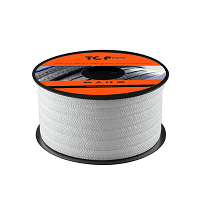
We consider ptfe gland packing when the fluid calls for broad chemical resistance. Within our SUNPASS range, a pure-fiber braid and a reinforced construction need different checks. Check every constituent exposed to the fluid, including lubricant and reinforcement.
The shortlist changes when a liquid carries grit. Particles can wear both the braid and its running surface. We need particle size and content where available, plus the sleeve condition. If the sleeve is deeply scored, changing the fiber leaves that damaged sealing surface in place.
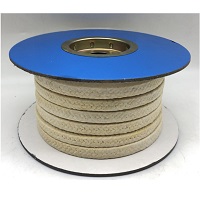
Aramid gland packing becomes relevant when abrasive media and resistance to deformation drive the selection. Our STYLE 6500 uses continuous-filament Kevlar yarn impregnated with PTFE emulsion and processed with lubricant. It can form a complete packing set or serve as end rings with another packing, where the application calls for that arrangement.
The STYLE 6500 data gives a pH range of 2–12 and a temperature range of −100°C to +280°C. Those figures define a screening boundary for this construction. A fluid outside that pH range needs another assessment, regardless of the fiber's strength.
The upper temperature is also not permission to combine maximum heat, pressure and speed.
An end-ring arrangement needs an application decision of its own. We would confirm the softer packing, ring positions and extrusion clearance before specifying a mixed set. Adding a hard-wearing ring without checking sleeve suitability can move the wear problem to a more expensive component.
Packing on a rotating shaft also has to handle frictional heat. How will that heat leave the box? The answer depends on the lubrication, permitted leakage and flush arrangement. On a packed pump, closing down every visible drop may remove a cooling route just as extra gland load raises friction.
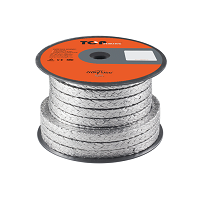
Graphite gland packing is a candidate for hot-water and steam duties. Our range includes reinforced and PTFE-impregnated constructions, which need separate evaluation. A graphite fiber's thermal capability does not establish the temperature rating of a finished braid containing other materials.
Operating atmosphere matters too. Graphite selection needs an oxidation assessment, especially where air or an oxidizing medium reaches hot packing. We do not transfer a temperature figure from an inert environment to air service. Specify continuous temperature and credible excursions, then obtain the grade's applicable limit for that environment.
Stuffing-box pressure is the relevant pressure for the packing assessment. Do not substitute a plant header rating without checking what reaches the sealing cavity. Record fluctuations alongside steady pressure, and describe the flush. We need to know when each condition occurs.
Diameter makes rpm meaningful at the packing surface. Take an illustrative shaft of 50 mm diameter at 1,450 rpm. Using π × diameter in metres × rpm ÷ 60 gives π × 0.050 × 1,450 ÷ 60 = 3.8 m/s, rounded. With a 100 mm shaft, the same calculation gives about 7.6 m/s at 1,450 rpm.
Twice the diameter means twice the surface speed here.
Read the equipment heading above a pressure or speed figure before using it. A rating for an intermittently moving valve stem does not describe continuous shaft rotation. We match the grade's rotary, reciprocating or valve data to your equipment, then ask whether pressure and speed are acceptable together. Separate maximum figures are insufficient evidence that the combination is acceptable.
The material comparison below identifies the question each candidate must answer. It is a screening guide, with no claim that one family replaces another across all duties.
| Candidate | Reason to consider it | Question before selection |
| PTFE construction | Chemical resistance | Are all constituents compatible with process and cleaning media? |
| STYLE 6500 aramid construction | Abrasive service and end-ring use | Do chemistry, sleeve condition and combined duty fit this grade? |
| Graphite construction | Hot-water or steam service | Are reinforcement, atmosphere and temperature limits suitable? |
Your service record should also include shaft diameter, packing section and stuffing-box depth. These dimensions determine fit and help establish the ring arrangement. Keep normal conditions separate from excursions. A list containing only the highest number from each operating variable can describe a duty the equipment never actually sees.
The final choice should identify a specific construction, its dimensions and the agreed operating conditions. Chemistry removes unsuitable materials. The remaining candidate still has to survive the abrasive and thermal duty at the machine's pressure and surface speed.
An unknown stuffing-box pressure, for example, leaves a specific gap to resolve before approving the grade.
Send SUNPASS the service conditions and equipment dimensions so we can discuss a suitable packing construction for your application.
We would not identify a grade from color alone. A dark braid might contain graphite-filled PTFE or be a graphite construction. Use the original grade reference or establish the construction before choosing an equivalent.
A pressure rating answers only part of the question. The packing must also suit the medium, shaft motion and heat removal available in that pump.
Yes. Give us the cleaner's name, concentration and temperature, together with how long the packing is exposed. Production fluid data alone leaves that exposure unchecked.
Only after the individual duties are checked. Different media, temperatures and stem movements can require different constructions even where the nominal valve sizes match.
Record leakage behavior, temperature changes, adjustments and sleeve condition alongside operating data. That history helps distinguish a material mismatch from a fit, lubrication or equipment problem.
Sunpass Sealing Technology (Zhejiang) Co. LTD
• Zhejiang Top Sealing and Insulation Co.,Ltd.
• Echo Industry Limited
• Tenglong Sealing and Thermal Insulation Manufactory
 Add: No. 78 West Road Zhenxing, Lianghui Industry Zone, Yuyao, Zhejiang, China
 Tel: +86 574 62837603
 E-mail: sales@sealings.cn