


When pressure pushes soft packing into a slurry pump's clearances, the whole ring may not need a harder braid. Aramid corner reinforced packing adds strength at the corners while retaining a conformable PTFE yarn body. Whether that helps your pump depends on what moves through the stuffing box, how the shaft moves and where the packing can deform.
Corner reinforcement places aramid yarn along the four corners of the braided square section. The PTFE yarn forms the main body. Once the packing is cut into rings and compressed inside the stuffing box, the body conforms to the available space while the reinforced regions provide additional mechanical strength.
Aramid's contribution comes from its strong fibers and resistance to abrasive wear. Within the broader range of aramid fiber packing, a corner reinforced braid concentrates that reinforcement in selected parts of the section. It differs from a braid made predominantly from aramid yarn, even when both products contain PTFE impregnation.
Extrusion resistance matters when pressure tends to push a softer packing into equipment clearances. Reinforcement can help the braid retain its section, but it cannot restore a worn sleeve or correct an excessive clearance. The equipment condition remains part of the sealing problem.
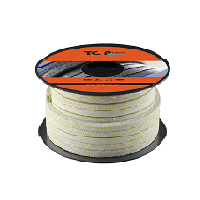
The PTFE portion gives the composite a relatively low friction sealing body. The shaft or rod sees a braided contact surface, so the placement of the stronger yarn matters as much as its presence. Keeping PTFE in the body preserves a conformable sealing region between the reinforced corners.
At SUNPASS, our STYLE 6500PTFE PTFE aramid packing combines pure PTFE yarn with aramid yarn at the corners. The construction also uses PTFE emulsion impregnation and a synthetic lubricant to support initial running. Here, “pure PTFE yarn” describes one component. The finished packing contains aramid and lubricant as well.
Lubrication still needs attention during operation. A lubricated braid can generate heat if the gland is overtightened or the application lacks the required cooling and flushing. Initial lubricant helps running in, but it does not establish a universal dry running capability or eliminate the need for the equipment's operating procedure.
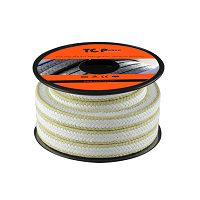
Abrasive service gives corner reinforcement a clear purpose. Sand bearing water, slurry and wastewater can expose packing to solids while the equipment moves. Reinforced corners add resistance to wear and deformation, while the PTFE body provides a more conformable sealing region.
Pulp and paper equipment is another relevant application. A maintenance engineer evaluating packing for a particular pump needs to consider the process liquid and any entrained solids together. A packing that withstands abrasive contact still needs suitable chemical resistance, lubrication and a sound sleeve surface.
Piston pumps introduce a different motion. The rod reverses direction rather than rotating continuously, so a successful installation elsewhere on a rotary pump does not establish suitability. Our STYLE 6500PTFE application range includes piston pumps and valves, but each duty still needs confirmation against the operating conditions and equipment design.
Petrochemical applications require the same distinction between an industry name and a defined fluid service. Oils, solvents and diluted acids or alkalis appear within the product's application scope. That scope does not cover every process stream in a petrochemical plant, especially mixtures or cleaning cycles with more aggressive chemistry.
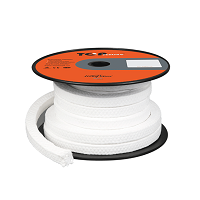
The complete braid has narrower limits than a favorable description of one constituent might suggest. The broader range of PTFE gland packing includes several braid constructions. Check chemical compatibility for the reinforced grade itself, including its aramid yarn and lubricant.
For STYLE 6500PTFE, the specified temperature range is −100 to +260°C and the stated pH range is 2–12. These values describe the named packing. They do not establish that maximum temperature, pressure and shaft speed can be combined, or that every fluid within that pH range is compatible.
Chemical identity matters beyond pH. The product excludes concentrated acids and concentrated alkalis, along with alkali metals, fluorine and fluorine compounds at high temperatures. A dilute process fluid and a concentrated cleaning solution therefore need separate consideration, even when both pass through the same equipment.
Mechanical wear also has several causes. Aramid reinforcement addresses the braid's strength and wear resistance, while abrasive particles, sleeve condition and excessive compression can still damage the contact surfaces. A longer service life cannot be promised from the fiber name alone. Compare operating records under equivalent conditions if you need to establish an actual improvement.
Aramid corner reinforced packing is most useful when a PTFE body needs additional support against abrasion and extrusion. The construction gives you a specific reason to consider a composite braid, provided the full fluid exposure and operating conditions remain within the product's limits. For a replacement assessment, identify the existing packing's failure mechanism before changing materials.
If your team is evaluating this construction, share the fluid and cleaning chemistry, temperature, pressure, movement and stuffing box dimensions with us so we can review the appropriate SUNPASS packing construction.
No. In the PTFE and aramid construction described here, PTFE yarn forms the body and aramid yarn reinforces the corners. Predominantly aramid braids are a separate construction.
No. Impregnation does not remove the compatibility limits of the other constituents. Check the complete packing against the actual process and cleaning fluids.
Corner reinforcement runs within the braided section. Separate end rings occupy particular positions in a packing set. Those arrangements serve different design functions and require application specific selection.
No. A graphite PTFE body has a different composition from the pure PTFE yarn body discussed here. Confirm the exact grade before applying specifications or comparing operating behavior.
No. Square section and installed ring arrangement must still suit the stuffing box. Reinforcement changes construction, while dimensional fit remains a separate requirement.
Sunpass Sealing Technology (Zhejiang) Co. LTD
• Zhejiang Top Sealing and Insulation Co.,Ltd.
• Echo Industry Limited
• Tenglong Sealing and Thermal Insulation Manufactory
 Add: No. 78 West Road Zhenxing, Lianghui Industry Zone, Yuyao, Zhejiang, China
 Tel: +86 574 62837603
 E-mail: sales@sealings.cn