


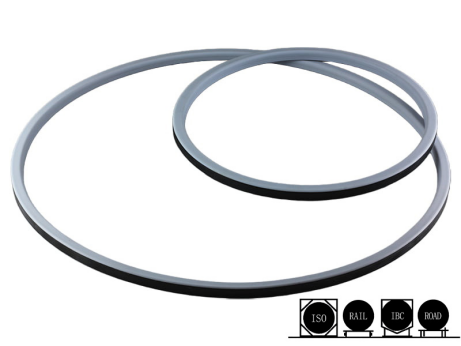
A manlid seal can look like a small replacement part, yet it controls whether a tank container stays clean, tight and ready for its next load. Food products demand a non-contaminating contact surface, while chemical media demand resistance to swelling and attack. A Super Tank Seal addresses both needs through a PTFE-covered EPDM structure, provided the design, installation and inspection routine match the tank service.
Food-grade service puts hygiene and cleanability first. A sealing material should not shed fillers, absorb the product or release additives during storage and transport.
Chemical service adds a different question: will acids, alkalis, solvents or oils change the seal volume and hardness? A rubber-only seal may provide useful recovery but can swell in aggressive media. A pure PTFE seal resists many chemicals, yet its low elasticity can make it less forgiving when a manlid surface is imperfect or the cover is opened repeatedly.
The practical selection question is therefore not simply “PTFE or rubber?” It is whether the contact layer can isolate the medium while an elastic core keeps the joint loaded. That is the operating logic behind a Super Tank Seal for tank-container manlids.
The outer layer uses virgin PTFE across the upper, lower and inner medium-contact faces. PTFE provides a chemically inert, non-adsorbent surface with low friction. For a food tank, that surface supports thorough cleaning and reduces the chance that the seal becomes a source of product carryover. For chemical service, it separates the medium from the core and helps resist swelling, cracking and degradation.
The EPDM core sits inside the PTFE cover and supplies resilience. After the manlid is tightened, the core can recover from compression and accommodate small surface irregularities or installation variation. That compensation matters because a rigid seal can lose contact when the cover, groove or flange is not perfectly uniform. The two materials solve different parts of the same sealing problem: PTFE protects the medium boundary, while EPDM maintains contact force.
Temperature and pressure should still be checked against the tank and the actual medium. The standard information for this product gives a working range of about -25°C to +110°C, short steam exposure up to 120°C, and use on tanks up to 4 bar. These figures describe a product configuration, not permission to ignore the tank maker’s instructions. A buyer should confirm section size, groove geometry and media compatibility before release.
Food and beverage applications usually have a narrow tolerance for contamination and difficult cleaning. The seal should have a smooth contact face, no loose filler and a construction that does not create channels where residue can remain. A PTFE-covered design helps keep the product-facing surface non-stick and non-porous. Operators still need to remove the ring, inspect the groove and follow the site’s validated cleaning and sanitation procedure; material choice cannot replace process control.
Chemical transport covers a wide range of media, so “chemical resistant” is only a starting point. The procurement file should name the medium, concentration, temperature, pressure and exposure time. PTFE is selected for broad resistance to acids, alkalis, organic solvents and oils, while EPDM provides the recovery needed after compression. If a chemical falls outside the confirmed range, request a compatibility review rather than assuming that a familiar seal will perform the same way.
Before fitting, clean the groove and inspect it for cuts, burrs, corrosion or old material. Check that the ring section and manlid diameter match the drawing.
Seat the ring evenly without twisting, then tighten the cover in the specified sequence and torque range. Excessive force can damage the seal or distort the cover; insufficient force can leave a leak path. After cleaning or transport cycles, inspect for flattening, cuts, permanent set or chemical attack and record the finding with the tank’s maintenance history.
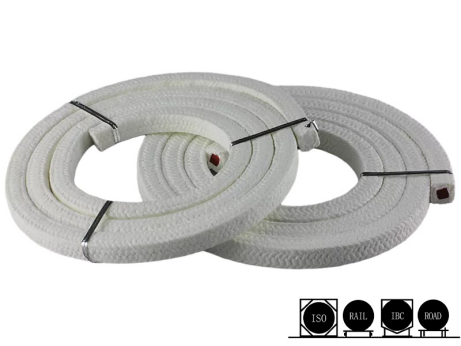
SUNPASS SEALING supplies manlid sealing options for different operating priorities. The Super Tank Seal combines a PTFE outer layer with an EPDM core; a PTFE braided manlid seal uses a braided construction, with PTFE-impregnated and pure-PTFE material options that must be distinguished when specifying the seal. Related selections include rubber seals, O-rings, metal winding pads, pure EPDM gaskets and natural rubber seals.
SUNPASS is a qualified supplier to globally known tank-container manufacturers, with markets across more than 60 countries. Its one-stop service covers material selection, dimensional customization and supporting ISO tank container spare parts. The company states that it has operated since 1979 and uses vacuum-capable high-pressure equipment with mature production processes developed over more than two decades. Buyers should match any certificate or approval requirement to the specific order and service condition.
For food tank containers, a cleanable PTFE contact surface is central to contamination control. For chemical tank containers, confirmed media compatibility comes first. The EPDM core then adds recovery when the manlid is opened, closed and compressed through repeated service. A Super Tank Seal is most useful when these material roles are matched with the correct section, groove, torque and inspection routine.
A Super Tank Seal is a composite manlid gasket with a PTFE-covered surface and an EPDM elastic core, designed for tank-container or storage-tank manholes.
It can be suitable when the selected PTFE material, dimensions and cleaning process meet the application’s food-contact requirements. Confirm the order-specific documentation before use.
PTFE provides the medium-facing chemical and hygiene barrier, while EPDM supplies elastic recovery and tolerance for small sealing-surface variation.
Identify the medium, concentration, temperature, pressure and exposure time, then verify them against the seal configuration and the tank manufacturer’s limits.
A one-stop order can include PTFE braided seals, pure PTFE seals, rubber seals, O-rings, metal winding pads, pure EPDM gaskets and natural rubber seals.
Sunpass Sealing Technology (Zhejiang) Co. LTD
• Zhejiang Top Sealing and Insulation Co.,Ltd.
• Echo Industry Limited
• Tenglong Sealing and Thermal Insulation Manufactory
 Add: No. 78 West Road Zhenxing, Lianghui Industry Zone, Yuyao, Zhejiang, China
 Tel: +86 574 62837603
 E-mail: sales@sealings.cn